 Add to Chrome
 Add to Firefox
 Add to Edge
Beyond Mode Collapse: Distribution Matching for Diverse Reasoning
May 19, 2026
On-policy reinforcement learning methods like GRPO suffer from mode collapse: they exhibit reduced solution diversity, concentrating probability mass on a single solution once discovered and ceasing exploration of alternative strategies. We show this stems from reverse KL minimization's mode-seeking behavior, which reinforces the first high-reward trajectory found rather than maintaining a distribution over multiple diverse solutions. We propose DMPO (Distribution-Matching Policy Optimization), which prevents mode collapse through principled approximation of forward KL minimization. DMPO constructs a group level target distribution over sampled trajectories proportional to their rewards, then aligns the policy distribution to this target. This provides mode-covering behavior without requiring sampling from the intractable global target distribution, enabling sustained exploration throughout training. We validate DMPO on NP-hard combinatorial optimization, where exponentially many feasible solutions exist but only a few approach optimality, an ideal testbed for evaluating exploration. DMPO achieves 43.9% Quality Ratio on text-based NP-Bench (vs. GRPO's 40.1%) and 43.1% on vision-based NP-Bench (vs. 38.4%), demonstrating 9% and 12% relative improvements respectively. These gains generalize to mathematical reasoning (+2.0%) and out-of-domain tasks (+2.3%), showing that diversity-preserving training enhances general reasoning capabilities across modalities. Our work establishes distribution matching as a practical, principled approach to preventing mode collapse in on-policy RL, with consistent quality improvements demonstrating sustained exploration across diverse reasoning tasks.

What and When to Distill: Selective Hindsight Distillation for Multi-Turn Agents
May 19, 2026Reinforcement learning can train LLM agents from sparse task rewards, but long-horizon credit assignment remains challenging: a single success-or-failure signal must be distributed across many actions. Existing methods rely on trajectory-level rewards or proxy signals, without fully leveraging per-step environmental feedback. Multi-turn agent settings are underexplored, where feedback can include error messages, page changes, observations, or reference trajectories. We systematically study five feedback sources and two insertion granularities and introduce SERL, a selective environment-reweighted learning framework. SERL uses the task reward to determine update direction, while environment feedback adjusts placement and magnitude, focusing on critical actions. On ALFWorld and WebShop, SERL achieves 90.0% and 80.1% success, outperforming strong RL and distillation baselines. Analysis shows that grounded, action-relevant feedback at meaningful points consistently outperforms indiscriminate use of longer or richer context.
COSMO-Agent: Tool-Augmented Agent for Closed-loop Optimization,Simulation,and Modeling Orchestration
Apr 07, 2026Iterative industrial design-simulation optimization is bottlenecked by the CAD-CAE semantic gap: translating simulation feedback into valid geometric edits under diverse, coupled constraints. To fill this gap, we propose COSMO-Agent (Closed-loop Optimization, Simulation, and Modeling Orchestration), a tool-augmented reinforcement learning (RL) framework that teaches LLMs to complete the closed-loop CAD-CAE process. Specifically, we cast CAD generation, CAE solving, result parsing, and geometry revision as an interactive RL environment, where an LLM learns to orchestrate external tools and revise parametric geometries until constraints are satisfied. To make this learning stable and industrially usable, we design a multi-constraint reward that jointly encourages feasibility, toolchain robustness, and structured output validity. In addition, we contribute an industry-aligned dataset that covers 25 component categories with executable CAD-CAE tasks to support realistic training and evaluation. Experiments show that COSMO-Agent training substantially improves small open-source LLMs for constraint-driven design, exceeding large open-source and strong closed-source models in feasibility, efficiency, and stability.
Intern-S1-Pro: Scientific Multimodal Foundation Model at Trillion Scale
Mar 26, 2026We introduce Intern-S1-Pro, the first one-trillion-parameter scientific multimodal foundation model. Scaling to this unprecedented size, the model delivers a comprehensive enhancement across both general and scientific domains. Beyond stronger reasoning and image-text understanding capabilities, its intelligence is augmented with advanced agent capabilities. Simultaneously, its scientific expertise has been vastly expanded to master over 100 specialized tasks across critical science fields, including chemistry, materials, life sciences, and earth sciences. Achieving this massive scale is made possible by the robust infrastructure support of XTuner and LMDeploy, which facilitates highly efficient Reinforcement Learning (RL) training at the 1-trillion parameter level while ensuring strict precision consistency between training and inference. By seamlessly integrating these advancements, Intern-S1-Pro further fortifies the fusion of general and specialized intelligence, working as a Specializable Generalist, demonstrating its position in the top tier of open-source models for general capabilities, while outperforming proprietary models in the depth of specialized scientific tasks.
Timely Machine: Awareness of Time Makes Test-Time Scaling Agentic
Jan 23, 2026As large language models (LLMs) increasingly tackle complex reasoning tasks, test-time scaling has become critical for enhancing capabilities. However, in agentic scenarios with frequent tool calls, the traditional generation-length-based definition breaks down: tool latency decouples inference time from generation length. We propose Timely Machine, redefining test-time as wall-clock time, where models dynamically adjust strategies based on time budgets. We introduce Timely-Eval, a benchmark spanning high-frequency tool calls, low-frequency tool calls, and time-constrained reasoning. By varying tool latency, we find smaller models excel with fast feedback through more interactions, while larger models dominate high-latency settings via superior interaction quality. Moreover, existing models fail to adapt reasoning to time budgets. We propose Timely-RL to address this gap. After cold-start supervised fine-tuning, we use reinforcement learning to enhance temporal planning. Timely-RL improves time budget awareness and consistently boosts performance across Timely-Eval. We hope our work offers a new perspective on test-time scaling for the agentic era.
TL-GRPO: Turn-Level RL for Reasoning-Guided Iterative Optimization
Jan 23, 2026Large language models have demonstrated strong reasoning capabilities in complex tasks through tool integration, which is typically framed as a Markov Decision Process and optimized with trajectory-level RL algorithms such as GRPO. However, a common class of reasoning tasks, iterative optimization, presents distinct challenges: the agent interacts with the same underlying environment state across turns, and the value of a trajectory is determined by the best turn-level reward rather than cumulative returns. Existing GRPO-based methods cannot perform fine-grained, turn-level optimization in such settings, while black-box optimization methods discard prior knowledge and reasoning capabilities. To address this gap, we propose Turn-Level GRPO (TL-GRPO), a lightweight RL algorithm that performs turn-level group sampling for fine-grained optimization. We evaluate TL-GRPO on analog circuit sizing (ACS), a challenging scientific optimization task requiring multiple simulations and domain expertise. Results show that TL-GRPO outperforms standard GRPO and Bayesian optimization methods across various specifications. Furthermore, our 30B model trained with TL-GRPO achieves state-of-the-art performance on ACS tasks under same simulation budget, demonstrating both strong generalization and practical utility.
Mixing Expert Knowledge: Bring Human Thoughts Back To the Game of Go
Jan 23, 2026Large language models (LLMs) have demonstrated exceptional performance in reasoning tasks such as mathematics and coding, matching or surpassing human capabilities. However, these impressive reasoning abilities face significant challenges in specialized domains. Taking Go as an example, although AlphaGo has established the high performance ceiling of AI systems in Go, mainstream LLMs still struggle to reach even beginner-level proficiency, let alone perform natural language reasoning. This performance gap between general-purpose LLMs and domain experts is significantly limiting the application of LLMs on a wider range of domain-specific tasks. In this work, we aim to bridge the divide between LLMs' general reasoning capabilities and expert knowledge in domain-specific tasks. We perform mixed fine-tuning with structured Go expertise and general long Chain-of-Thought (CoT) reasoning data as a cold start, followed by reinforcement learning to integrate expert knowledge in Go with general reasoning capabilities. Through this methodology, we present \textbf{LoGos}, a powerful LLM that not only maintains outstanding general reasoning abilities, but also conducts Go gameplay in natural language, demonstrating effective strategic reasoning and accurate next-move prediction. LoGos achieves performance comparable to human professional players, substantially surpassing all existing LLMs. Through this work, we aim to contribute insights on applying general LLM reasoning capabilities to specialized domains. We will release the first large-scale Go dataset for LLM training, the first LLM Go evaluation benchmark, and the first general LLM that reaches human professional-level performance in Go at: https://github.com/Entarochuan/LoGos.
MedCalc-Eval and MedCalc-Env: Advancing Medical Calculation Capabilities of Large Language Models
Oct 31, 2025As large language models (LLMs) enter the medical domain, most benchmarks evaluate them on question answering or descriptive reasoning, overlooking quantitative reasoning critical to clinical decision-making. Existing datasets like MedCalc-Bench cover few calculation tasks and fail to reflect real-world computational scenarios. We introduce MedCalc-Eval, the largest benchmark for assessing LLMs' medical calculation abilities, comprising 700+ tasks across two types: equation-based (e.g., Cockcroft-Gault, BMI, BSA) and rule-based scoring systems (e.g., Apgar, Glasgow Coma Scale). These tasks span diverse specialties including internal medicine, surgery, pediatrics, and cardiology, offering a broader and more challenging evaluation setting. To improve performance, we further develop MedCalc-Env, a reinforcement learning environment built on the InternBootcamp framework, enabling multi-step clinical reasoning and planning. Fine-tuning a Qwen2.5-32B model within this environment achieves state-of-the-art results on MedCalc-Eval, with notable gains in numerical sensitivity, formula selection, and reasoning robustness. Remaining challenges include unit conversion, multi-condition logic, and contextual understanding. Code and datasets are available at https://github.com/maokangkun/MedCalc-Eval.
InternBootcamp Technical Report: Boosting LLM Reasoning with Verifiable Task Scaling
Aug 12, 2025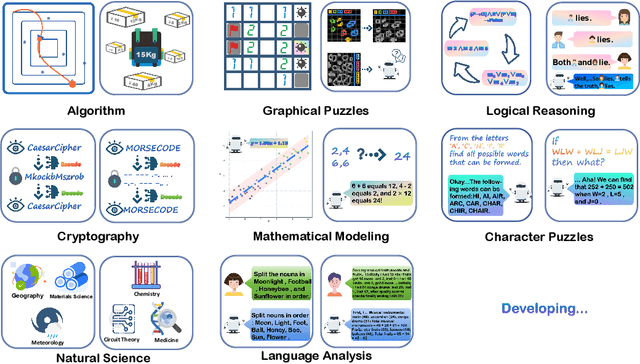
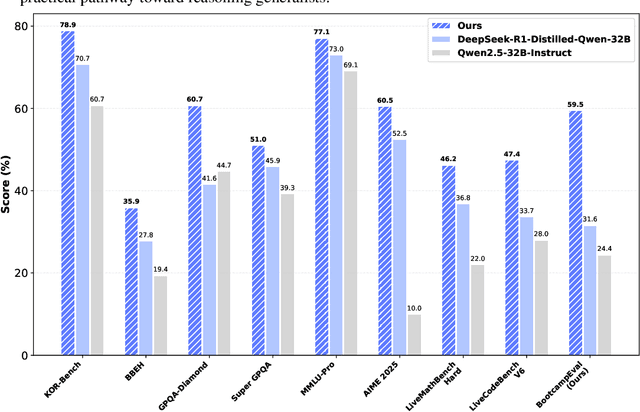

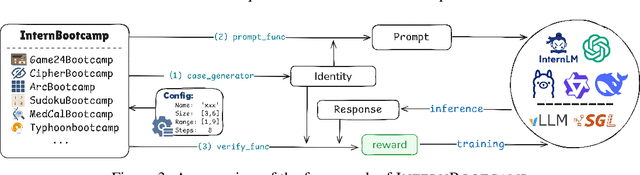
Large language models (LLMs) have revolutionized artificial intelligence by enabling complex reasoning capabilities. While recent advancements in reinforcement learning (RL) have primarily focused on domain-specific reasoning tasks (e.g., mathematics or code generation), real-world reasoning scenarios often require models to handle diverse and complex environments that narrow-domain benchmarks cannot fully capture. To address this gap, we present InternBootcamp, an open-source framework comprising 1000+ domain-diverse task environments specifically designed for LLM reasoning research. Our codebase offers two key functionalities: (1) automated generation of unlimited training/testing cases with configurable difficulty levels, and (2) integrated verification modules for objective response evaluation. These features make InternBootcamp fundamental infrastructure for RL-based model optimization, synthetic data generation, and model evaluation. Although manually developing such a framework with enormous task coverage is extremely cumbersome, we accelerate the development procedure through an automated agent workflow supplemented by manual validation protocols, which enables the task scope to expand rapidly. % With these bootcamps, we further establish Bootcamp-EVAL, an automatically generated benchmark for comprehensive performance assessment. Evaluation reveals that frontier models still underperform in many reasoning tasks, while training with InternBootcamp provides an effective way to significantly improve performance, leading to our 32B model that achieves state-of-the-art results on Bootcamp-EVAL and excels on other established benchmarks. In particular, we validate that consistent performance gains come from including more training tasks, namely \textbf{task scaling}, over two orders of magnitude, offering a promising route towards capable reasoning generalist.
UnitCoder: Scalable Iterative Code Synthesis with Unit Test Guidance
Feb 17, 2025Large Language Models (LLMs) have demonstrated remarkable capabilities in various tasks, yet code generation remains a major challenge. Current approaches for obtaining high-quality code data primarily focus on (i) collecting large-scale pre-training data and (ii) synthesizing instruction data through prompt engineering with powerful models. While pre-training data faces quality consistency issues, instruction-based synthesis suffers from limited instruction diversity and inherent biases of LLMs. To address this gap, we introduce UnitCoder, a systematic pipeline leveraging model-generated unit tests to both guide and validate the code generation process. Combined with large-scale package-based retrieval from pre-training corpus, we generate a dataset of 500K+ verifiable programs containing diverse API calls. Evaluations on multiple Python benchmarks (BigCodeBench, HumanEval, MBPP) demonstrate that models fine-tuned on our synthetic data exhibit consistent performance improvements. Notably, Llama3.1-8B and InternLM2.5-7B improve from 31\% and 28\% to 40\% and 39\% success rates on BigCodeBench, respectively. Our work presents a scalable approach that leverages model-generated unit tests to guide the synthesis of high-quality code data from pre-training corpora, demonstrating the potential for producing diverse and high-quality post-training data at scale. All code and data will be released (https://github.com).